Does Microsuction Hurt? An Honest Answer for Anyone Nervous About Ear Wax Removal
You’ve been putting this off.
Your ears feel blocked, your hearing is muffled, and you know you need to do something about it. But every time you think about booking an ear wax removal appointment, something stops you.
Maybe you’ve heard the word “suction” and imagined something painful. Maybe a friend told you it was loud and unpleasant. Maybe you read something online that scared you. Or maybe you just don’t like the idea of anyone putting instruments inside your ear.
If any of that sounds familiar, this article is for you. I’m going to tell you honestly what microsuction feels like, what actually happens during the procedure, and how to choose someone you can trust to do it safely.
No sugarcoating, no sales pitch—just the information you need to make a decision you feel comfortable with.
First, the Direct Answer: Does It Hurt?
For the vast majority of people, microsuction does not hurt.
What you’ll feel is unusual rather than painful. There’s a sensation of something gently working inside your ear canal, and you’ll hear the sound of the suction—which is louder than you might expect because it’s happening right next to your eardrum.
Most people describe it as:
- “Strange but not painful” •
- “A bit ticklish” •
- “Loud but tolerable” •
- “Mildly uncomfortable in places, but fine overall” •
- “Much easier than I expected”
Some people feel brief moments of sensitivity, particularly if the wax is very close to the eardrum or if there’s any inflammation in the ear canal. But this is typically fleeting—seconds, not minutes—and a good practitioner will adjust their technique or pause if you’re uncomfortable.
The honest truth is that most of the fear around microsuction comes from anticipation rather than the reality. The procedure is usually over in 15-20 minutes, and the relief of being able to hear clearly again far outweighs any brief discomfort.
Why Does It Sound So Scary?
The word “suction” doesn’t help. It conjures images of powerful vacuums and aggressive pulling— neither of which reflects what actually happens.
Microsuction uses a very fine, low-pressure suction device. Think of it less like a vacuum cleaner and more like a tiny, precise straw. The suction is gentle and controlled, and the practitioner can see exactly what they’re doing through a microscope or magnified loupe the entire time.
This visibility is actually what makes microsuction safer than older methods like syringing. There’s no “blind” flushing of water into your ear—everything is done under direct vision, which means the practitioner can see the wax, see your ear canal, and see how close they are to your eardrum at all times
The Horror Stories: Should You Be Worried?
If you’ve spent any time searching online, you’ve probably come across negative experiences. Someone whose ear hurt for days afterwards. Someone who felt dizzy. Someone whose hearing seemed worse, not better.
These accounts are real, and I’m not going to pretend bad experiences never happen. But context matters:
Most negative experiences share common factors:
- The procedure was rushed. Ear wax removal should never be hurried. When practitioners
are under time pressure (common in high-volume clinics), there’s less care taken with
technique. - The practitioner wasn’t adequately trained. Microsuction requires proper training and
ongoing practice. Not everyone offering this service has the same level of expertise - There was an underlying issue that wasn’t identified. Sometimes ear pain after wax removal
reveals an infection or inflammation that was hidden by the wax. This isn’t caused by the
microsuction—it was already there. - The wax was impacted and required more extensive work. Very hard, deeply impacted wax
is more challenging to remove and may cause more sensation during the procedure. - No pre-treatment was recommended. Using olive oil drops for a few days before your
appointment softens the wax significantly, making removal gentler and quicker.
What the statistics actually show:
Microsuction is considered one of the safest methods of ear wax removal available. Complications are rare when performed by trained professionals. A 2020 study published in the Journal of Laryngology & Otology found that microsuction had a very low complication rate, with the vast majority of patients reporting no adverse effects. cambridge.org
The horror stories are outliers, not the norm. But they do highlight why choosing the right practitioner matters—which brings us to the next question
How Do I Know If Someone Is Actually Qualified?
This is where it gets murky, and it’s a legitimate concern. Ear wax removal isn’t as tightly regulated as you might assume. Various providers offer microsuction, and their qualifications vary significantly:
Who performs microsuction:
- Audiologists — Hearing specialists with degrees in audiology. Ear examination and wax removal are core parts of their training.
- ENT doctors and nurses — Medical professionals specialising in ear, nose and throat conditions.
- Registered nurses with additional training — Some nurses complete specialist courses in ear care.
- Healthcare assistants with certificate training — Shorter courses that provide basic competency.
- High-street chains and franchises — Staff qualifications vary; some employ audiologists, others use staff with minimal training.
Red flags to watch for:
- No clear information about who will perform the procedure or their qualifications.
- Very low prices that seem too good to be true (may indicate rushed appointments or undertrained staff)
- No pre-appointment guidance about using ear drops
- No examination of your ear before the procedure begins
- Pressure to book additional services you didn’t ask about
- Unable to answer questions about their training or equipment
Questions worth asking:
- Who will be performing the procedure, and what are their qualifications?
- How long have they been doing microsuction?
- What equipment do you use?
- What happens if there’s a problem or you can’t remove all the wax?
- Do you use a microscope or loupes for magnification?
A reputable provider will answer these questions readily. If someone is evasive or dismissive, that tells you something.
What Actually Happens During Microsuction: Step by Step
Knowing exactly what to expect often reduces anxiety more than any reassurance can. Here’s what happens when you come in for microsuction:
Before you arrive
We’ll ask you to use olive oil or ear drops for 2-3 days before your appointment. This softens the wax, making it much easier (and more comfortable) to remove. Don’t skip this step—it makes a genuine difference
When you arrive
We’ll have a brief conversation about your ears. When did they start feeling blocked? Have you had ear problems before? Any pain, discharge, or dizziness? This helps us understand what we’re likely to find and whether there are any reasons to be cautious.
The examination
Before any wax removal, we examine your ears carefully. This tells us how much wax there is, how hard it is, and how close it is to your eardrum, and we will explain what we find before we start. For many people, this is actually reassuring. You know there’s genuinely wax in there (you’re not imagining it), and that your ear canal is a space your clinician can work in safely.
The procedure itself
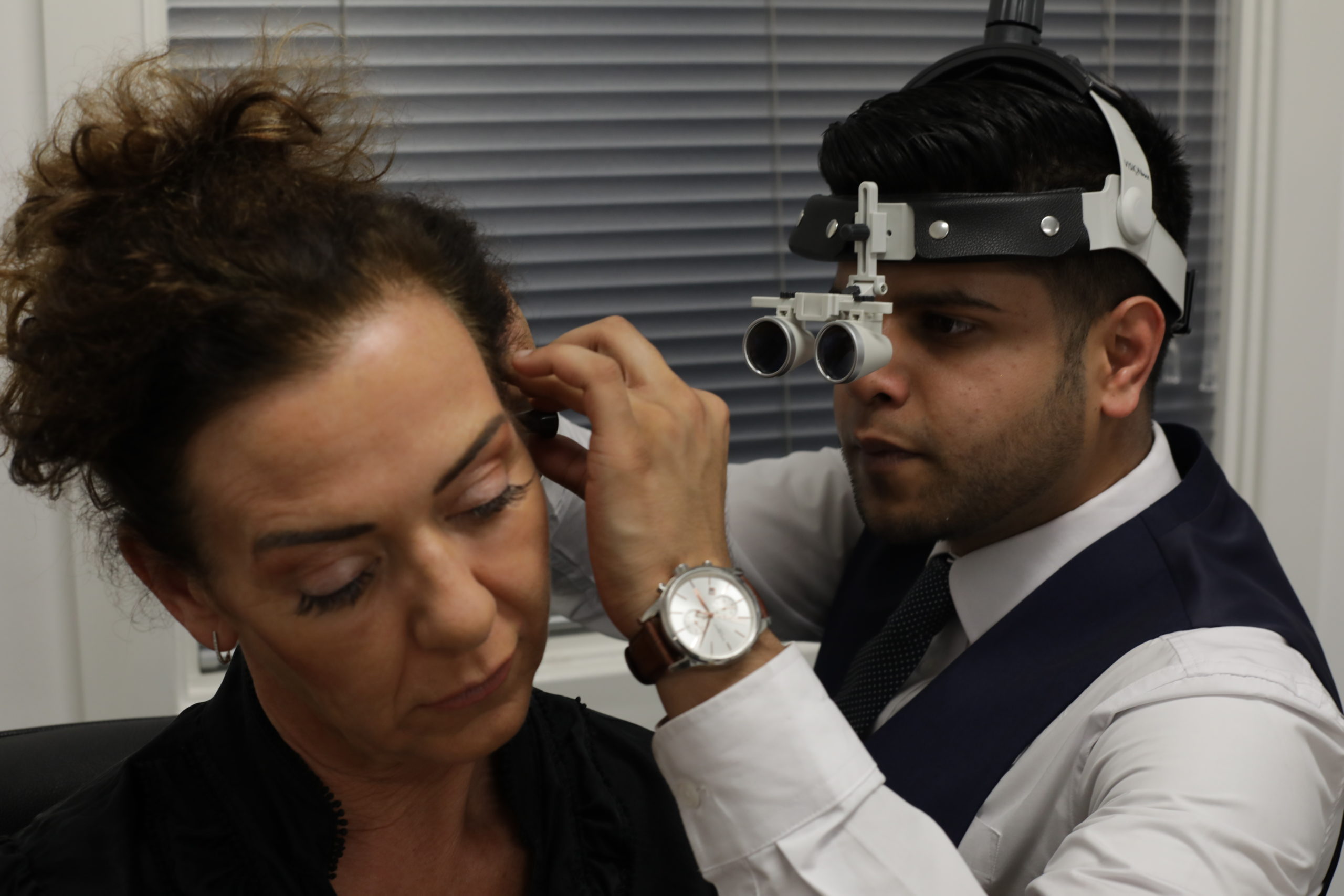
You’ll sit comfortably, usually with your head tilted slightly to one side. We use a microscope or magnifying loupes to see inside your ear clearly—everything is done under direct vision.
The microsuction device looks a bit like a thin metal tube. It’s connected to a suction unit that creates gentle negative pressure. We guide it into your ear canal and use it to lift and remove the wax piece by piece.
What you'll experience:
- Sound: The suction creates a noise that you’ll hear quite loudly because it’s inside your ear. It’s a sort of whooshing or crackling sound. It’s not painful, but it is noticeable. Some people find it startling at first, then get used to it within seconds.
- Sensation: You’ll feel the instrument in your ear canal. Most people describe it as a light pressure or a tickling feeling. It’s unusual, but not painful.
- Duration: Typically 5-10 minutes per ear, depending on how much wax there is and how hard it is. Very impacted wax may take longer.
- Communication: We’ll talk to you throughout. If you need a break, just say so. If something feels uncomfortable, tell us immediately and we’ll stop or adjust.
After the procedure
We’ll check your ear canal and eardrum again afterwards so you know the wax has gone. Most people are surprised by how much wax was in there—and relieved to have it gone.
Your hearing should improve immediately. Some people describe it as suddenly turning the volume up on the world. Sounds may seem almost too loud at first, simply because you’ve been hearing through a layer of wax for so long.
Occasionally there’s mild sensitivity or a slight residual “awareness” of your ear for an hour or two afterwards. This settles quickly.
"What If I Have Sensitive Ears?"
Some people have ear canals that are more sensitive than average—they may have had painful experiences with ear syringing in the past, or they find ear examinations uncomfortable.
This is worth mentioning when you book or at the start of your appointment. A good practitioner will:
- Use a smaller speculum (the cone-shaped attachment that goes into your ear)
- Work more slowly and gently
- Take more frequent breaks
- Use the lowest effective suction pressure
- Keep checking in with you about comfort
Sensitive ears don’t mean you can’t have microsuction—they just mean the approach needs to be adjusted.
"What If It Doesn't Work?"
Occasionally, wax cannot be fully removed in one appointment. This might happen if:
- The wax is extremely hard and impacted (despite using drops beforehand)
- There’s a lot of wax and removing it all in one session would cause unnecessary discomfort
- There’s an underlying issue like an infection that needs treating first If this happens, we’ll explain exactly what’s going on, what we managed to remove, and what the next steps are. This might mean a second appointment after more intensive drop use, or in rare cases, a referral to an ENT specialist.
Reputable providers have clear policies about what happens in these situations. Ask upfront: “What happens if you can’t remove all the wax?”
Microsuction vs Other Methods: What Are Your Options?
You might be wondering whether microsuction is even the right choice, or whether you should consider alternatives.
Ear syringing (irrigation)
What it is: Water is flushed into your ear canal using a pressurised pump to wash out the wax.
Pros: Can be effective for softer wax. Often available at GP surgeries (though increasingly rare).
Cons: Not suitable if you’ve had ear surgery, have a perforated eardrum, or have had ear infections. The water pressure can cause discomfort. Higher risk of ear infections afterwards. The practitioner can’t see what they’re doing—it’s essentially done “blind.”
NHS availability: Many GP practices have stopped offering syringing due to safety concerns and time constraints. nhs.uk
Ear drops alone
What they do: Soften wax so it can drain out naturally.
Pros: Cheap, safe, and sometimes sufficient for minor wax buildup.
Cons: Often not enough for significant blockages. Can take weeks. May soften wax without actually clearing it, temporarily making hearing worse.
Ear candles
What they claim: A hollow cone is lit and supposedly creates suction that draws wax out.
Reality: There’s no scientific evidence that ear candles work, and they carry genuine risks—burns, candle wax dripping into your ear canal, and perforated eardrums. The “residue” left in the candle after use is from the candle itself, not your ear. nhs.uk Healthcare professionals universally advise against ear candles.
Microsuction
Pros: Performed under direct vision, so the practitioner can see exactly what they’re doing. Safe for people with perforated eardrums or previous ear surgery. Quick, effective, and low risk of infection (no water involved). The gold standard method recommended by ENT specialists.
Cons: The sound can be loud and take some getting used to. Not available on the NHS in most areas. Costs money.
Why Prices Vary So Much
You’ve probably noticed that microsuction prices range wildly—from £30 to over £100 for essentially the same service. What’s going on?
Factors that affect pricing:
- Practitioner qualifications: A highly experienced audiologist or ENT specialist typically charges more than someone with basic certificate training.
- Time allocated: A 15-minute appointment slot is very different from 30-40 minutes. Rushed appointments may be cheaper but offer less thorough care.
- Location: Central London prices are higher than suburban clinics. Rent and business costs are reflected in pricing.
- Equipment quality: Professional-grade microsuction equipment and microscopes are expensive. Cheaper setups may use lower-quality equipment.
- What’s included: Some prices cover both ears; others charge per ear. Some include follow-up if needed; others charge again.
What to look for:
A reasonable price for professional microsuction in South London is typically £60-90 for both ears. Significantly cheaper than this may indicate compromises on time or training. Significantly more expensive isn’t necessarily better—check what you’re actually getting.
Our pricing is transparent: £60 for one ear, £80 for both ears (currently on a limited-time offer). This includes a thorough examination before and after, as much time as needed to remove the wax properly, and advice on preventing future buildup. There’s a £20 consultation fee if we examine your ears and find no wax—because you’re paying for professional time either way.
What Happens If Something Goes Wrong?
Let’s address this directly, because it’s a real concern.
Possible side effects (rare but real):
- Temporary sensitivity or discomfort — Your ear may feel slightly tender for an hour or two. This usually resolves quickly.
- Minor bleeding — Occasionally, very dry or impacted wax is stuck to the ear canal skin, and removing it may cause a tiny amount of bleeding. This heals rapidly.
- Dizziness — If the suction gets very close to the eardrum, it can briefly stimulate the balance system. This passes within seconds to minutes.
- Tinnitus — Very rarely, people report temporary ringing in the ear after the procedure. This typically resolves within hours.
- Incomplete wax removal — Sometimes not all wax can be removed in one session.
Serious complications (very rare):
- Eardrum perforation — Extremely uncommon with trained practitioners using proper technique and equipment. The risk is much lower than with syringing because everything is done under direct vision.
- Ear canal trauma — Again, very rare with proper technique.
What we do to minimise risks:
- Full examination before starting
- Use of magnification throughout
- Working slowly and carefully
- Checking in with you constantly
- Stopping immediately if you experience pain
If you have concerns after your appointment:
We provide clear aftercare guidance and our contact details. If something doesn’t feel right in the hours or days following your appointment, get in touch. If there’s an issue, we want to know about it and help you resolve it.
You're Allowed to Be Nervous
Here’s something worth saying: being anxious about microsuction is completely normal.
Most people who come to us for the first time admit they’ve been putting it off. They’re not sure what to expect, they’ve read things online that worried them, or they just don’t like the idea of someone working inside their ear.
All of that is valid.
What usually happens is this: the anticipation is worse than the reality. Within 30 seconds of the procedure starting, most people relax because they realise it’s genuinely fine. And when they hear clearly again afterwards, they wonder why they waited so long.
You can tell us you’re nervous—we hear it every day. We’ll explain everything as we go, check in with you frequently, and stop whenever you need a moment. You’re in control.
Why Choose The Hearing Specialist?
With dozens of options for ear wax removal in South London, you might wonder what makes us different. Here’s what we think matters:
Qualified, experienced practitioners. Our ear wax removal is performed by trained audiologists and clinical ear care specialists—not healthcare assistants with weekend certification courses.
Time to do it properly. We don’t book back-to-back appointments with five-minute turnarounds. Your appointment is long enough to examine your ears, discuss any concerns, remove the wax carefully, and answer your questions.
Proper equipment. We use professional-grade microsuction equipment and examine your ears before and after the procedure.
Part of a full hearing care service. If your hearing doesn’t return to normal after wax removal, we can investigate further with a comprehensive hearing assessment. You won’t need to start again somewhere else—we can help you understand the full picture.
Clear, honest communication. We’ll tell you what we find, what we recommend, and why. If your ears turn out to be clear and you don’t need wax removal, we’ll tell you that too (there’s a £20 consultation fee for our time, but we won’t pretend there’s wax when there isn’t).
Convenient locations. We have clinics in Wimbledon, Teddington, and Wallington, plus home visits for those who can’t easily travel.
Preparing for Your Appointment: A Quick Checklist
To get the best experience and outcome:
2-3 days before:
- Use olive oil or ear drops (like Earol or Otex) twice daily in the affected ear(s)
- This softens the wax significantly and makes removal easier and more comfortable
On the day:
- Arrive on time—we need the full appointment for proper care
- Tell us if you’re nervous, have sensitive ears, or have had problems with ear procedures before
- Mention any ear conditions, previous ear surgery, or perforated eardrums
Bring:
- Any relevant medical history
- Questions you want answered
- Someone for moral support if that helps (they’re welcome to wait with you)
Ready to Book?
If you’ve been putting off dealing with your blocked ears, now might be the time.
We offer microsuction ear wax removal at our clinics in Wimbledon, Teddington, and Wallington, with appointments available Monday through Saturday. Home visits are also available if getting to a clinic is difficult for you.
Current pricing:
- One ear: £60
- Both ears: £80 (limited time offer)
- Consultation fee if no wax found: £20
Book online: thehearingspecialist.co.uk Call: 020 8150 7178 You’ve been living with muffled hearing long enough. Let’s sort it out—gently, professionally, and without the anxiety.
Ready to rediscover clear sound?
Contact your local clinic today to trial the latest BTE and ITE technology.