

If you have recently discovered that you need hearing assistance, the sheer volume of choices can be overwhelming. Modern audiology has moved far beyond the clunky, beige boxes of the past, offering sleek, high-tech devices that are as much about lifestyle as they are about health.
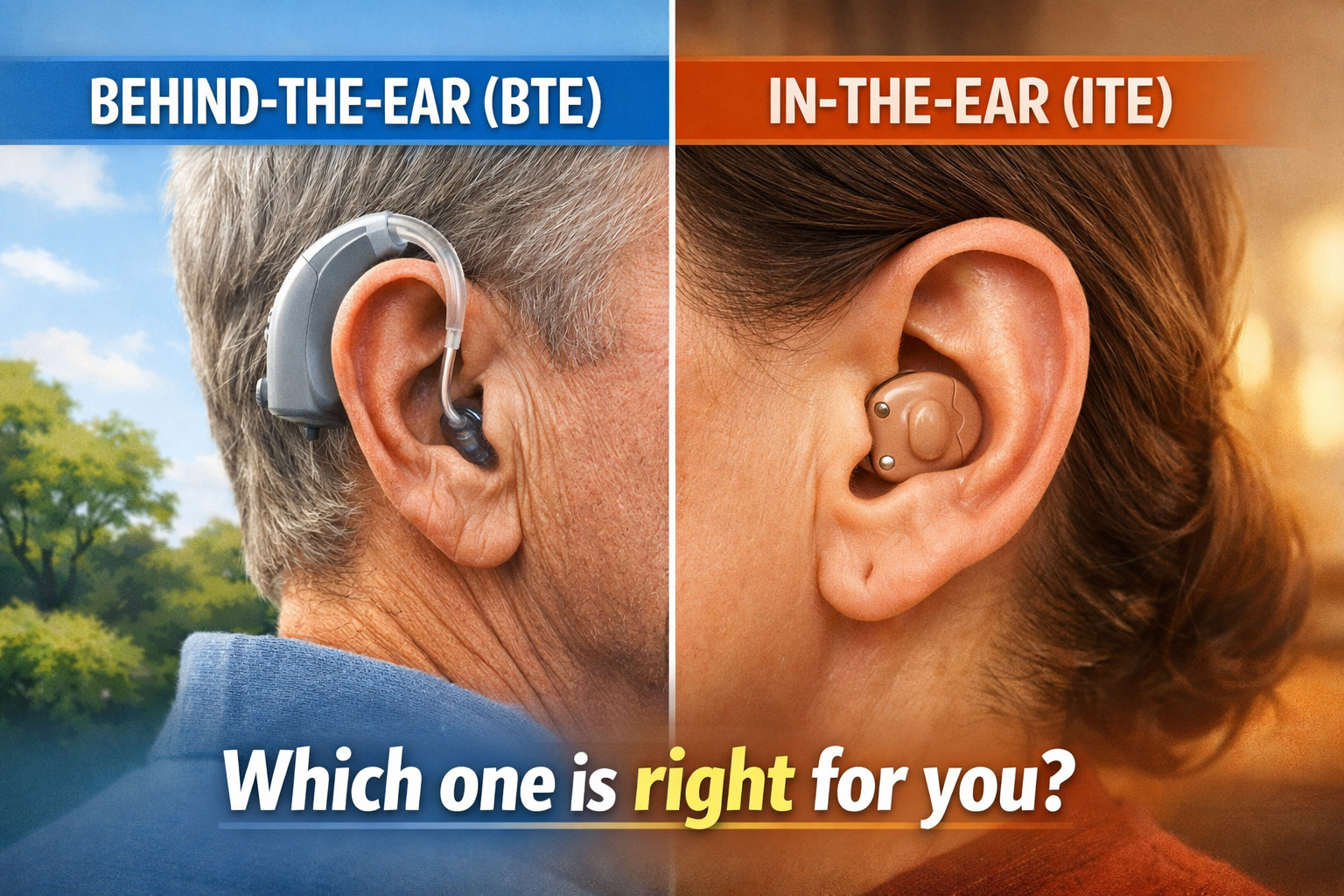
The core of your decision usually comes down to a choice between two primary formats: Behind-the-Ear (BTE) and In-the-Ear (ITE). Both are excellent choices, but they cater to very different priorities. In this guide, we dive deep into the mechanics, aesthetics, and practicalities of each.
Behind-the-Ear (BTE) Hearing Aids
Behind-the-Ear models are the most common style globally. They consist of a casing that rests snugly behind the outer ear, connected to the ear canal via a transparent tube or a thin wire (if it’s a Receiver-in-Canal or RIC model).
Why choose BTE?
- The Powerhouse Factor: Because BTE devices are slightly larger, they can house more sophisticated processing chips and larger amplifiers. This makes them the only real choice for those with profound hearing loss.
- Rechargeable Ease: Most BTE models now come with lithium-ion rechargeable batteries. You simply pop them in a dock at night, eliminating the need to fiddle with tiny disposable batteries.
- Feature Rich: From dual-microphones for better noise cancellation to telecoils for loop systems in theatres, BTEs rarely compromise on features.
The Challenges
The main drawback for some is the physical presence behind the ear. If you wear heavy-framed spectacles or a face mask, the “real estate” behind your ear can get crowded. Additionally, while they are much smaller than they used to be, they remain more visible from a side profile.
In-the-Ear (ITE) Hearing Aids
In-the-Ear models are custom-moulded to fit the unique shape of your ear. They range from “Full Shell” (which fills the outer bowl) to “Completely-in-Canal” (CIC), which is virtually invisible.
Why choose ITE?
- The Invisibility Factor: For those concerned about the stigma of wearing a hearing aid, a CIC or IIC (Invisible-in-Canal) model is the ultimate solution.
- Natural Acoustics: By placing the microphone inside the ear canal, these devices utilize the pinna (the outer ear) to naturally funnel sound, providing better spatial awareness.
- Phone Friendly: You can hold a telephone to your ear just like you normally would, without having to worry about feedback or finding the right angle for an external microphone.
The Challenges
Because they sit inside the ear, they are highly susceptible to earwax and moisture damage. They require a daily cleaning regime to stay functional. Furthermore, their small size often means they lack certain features like Bluetooth streaming or volume toggle switches.
The Comparison Table
| Feature | Behind-the-Ear (BTE) | In-the-Ear (ITE) |
|---|---|---|
| Degree of Loss | Mild to Profound | Mild to Moderate |
| Discretion | Sleek, but visible | Minimal to Invisible |
| Battery Type | Rechargeable or Size 13/312 | Mostly disposable (10/312) |
| Connectivity | Excellent (Bluetooth/Loops) | Limited in smaller models |
| Maintenance | Moderate | High (Daily cleaning) |
Three Questions to Ask Yourself
Before you book your appointment, consider these three lifestyle factors:
1. How is your dexterity?
ITE batteries are roughly the size of a grain of rice. If you struggle with arthritis or fine motor skills, a larger BTE model with a rechargeable dock will save you a lot of daily frustration.
2. Are you a “tech-heavy” user?
If you want to stream Spotify or take phone calls directly through your hearing aids, BTE models currently lead the pack in stable Bluetooth connectivity.
3. What environments do you frequent?
If you spend a lot of time in windy outdoor environments (like golf courses or hiking), ITE models are naturally shielded from wind noise by the ear itself, whereas BTE microphones can sometimes struggle with the “whistling” effect of the breeze.
The Audiologist’s Verdict: While your preference matters, the shape of your ear canal and the specific frequencies of your hearing loss will ultimately dictate which model will perform best. Never buy a device without a professional hearing test.
Ready to rediscover clear sound?
Contact your local clinic today to trial the latest BTE and ITE technology.